 yapern
Does the Crichton Estate Have a Case?
Warner Bros. owns ER. It also promised Michael Crichton that certain things could only happen with his agreement. Those two facts can coexist, and they explain why his estate has a serious case over The Pitt.
The awkward part is how the new show got started. Noah Wyle and John Wells explored bringing ER back, negotiations with Crichton’s estate fell apart, and much of the same team went on to make another emergency-room drama starring Wyle. The estate says they continued the revival under a new name. The producers say they made a different show. The appellate opinion lays out both accounts.
On November 4, 2026, California’s Court of Appeal allowed the contract claims against Warner Bros. Television to continue. It also ordered the claims against Wyle, Wells, R. Scott Gemmill, John Wells Productions, and WarnerMedia Direct dismissed. Nobody has won a judgment that The Pitt is an unauthorized ER derivative. That ruling gives the estate a chance to prove it.
The promise Warner Bros. made
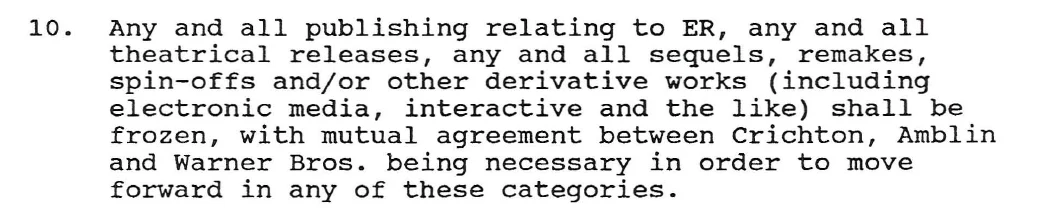
Crichton’s 1994 deal transferred rights in ER to Warner Bros. but froze sequels, remakes, spinoffs, and other derivative works unless Crichton, Spielberg’s Amblin, and Warner Bros. mutually agreed to proceed. Crichton died in 2008. Roadrunner JMTC LLC, controlled by his widow, Sherri Crichton, now holds his contractual rights. Amblin isn’t a party to this lawsuit. The court reproduces the relevant provisions.
A studio can own the copyright and still have a contractual obligation to ask permission. Ownership doesn’t erase a promise made to obtain it. The argument here is over whether The Pitt falls within what Warner Bros. promised to freeze.
Paragraph 10 of the original deal is short enough to inspect directly. This crop comes from the contract attached to the complaint, PDF page 27.
How the revival fell apart
The estate’s account of the negotiations includes correspondence involving Sherri, Wyle, and Wells. These are allegations and quoted exchanges in a pleading, rather than findings after a trial.
| When | What happened |
|---|---|
| February 2020 | According to the complaint, Wyle approached Wells about returning as John Carter, following an older doctor through a 14-hour shift. |
| Late 2022 | Wells contacted Sherri. A subsequent Warner Bros. offer acknowledged the estate’s approval rights. |
| Early 2023 | The estate says an agreement in principle included support for Crichton’s creator credit, with a $5 million guarantee if it wasn’t obtained. It alleges later demands removed that guarantee and worsened the financial terms. No final deal followed. |
| March 26, 2024 | Max announced a 15-episode order for The Pitt, with Wyle, Wells, and Gemmill. |
| August 27, 2024 | Roadrunner filed suit in Los Angeles, alleging the new show circumvented the frozen rights. |
The 14-hour idea matters because a long shift was already part of the proposed revival. The Pitt ultimately follows a 15-hour shift across fifteen episodes. That difference is worth discussing, but “one shift” by itself doesn’t establish that the later format was independently conceived.
Wyle acknowledges the abandoned revival. In his 2025 interview with Variety, he describes changing the character, visual style, music, and format after the team couldn’t reach terms with the estate. John Carter’s wealthy background gave way to Dr. Michael “Robby” Robinavitch’s different background and temperament. Wyle’s account is that they wanted new creative work, and he describes the dispute as deeply disappointing.
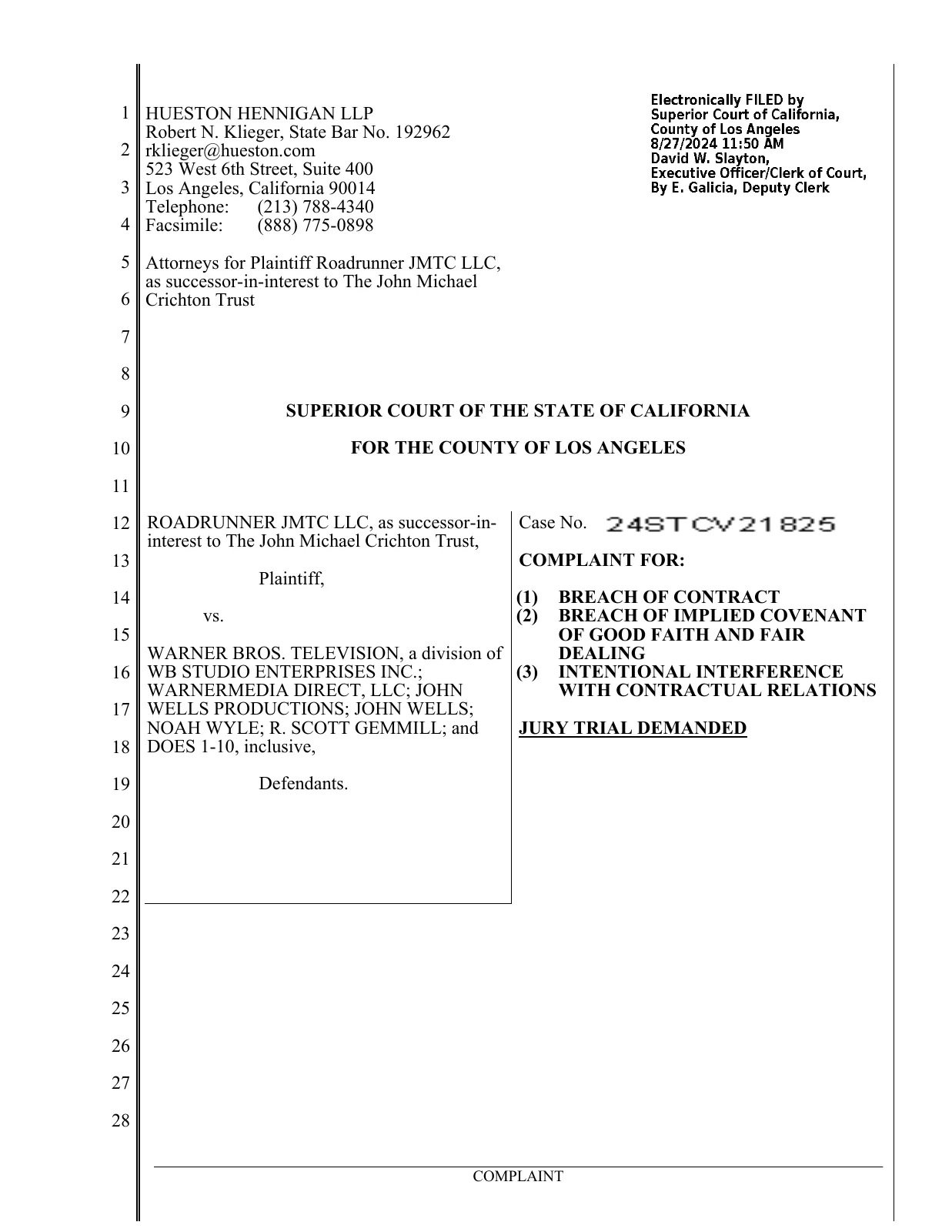
The first page of the original complaint makes the legal route visible: contract, good faith, and interference with contract. It doesn’t plead a federal copyright-infringement claim. The defendant list below is the original 2024 list, before the appellate dismissals.
What the court allowed, and what it rejected
The defendants tried to end the case under California’s anti-SLAPP law, which provides an early dismissal procedure for certain claims arising from protected expression. Judge Wendy Chang denied that motion in February 2025. The appeal concerned whether the estate had shown enough merit to proceed, with favorable inferences drawn from its evidence. That’s a much smaller question than who should win at trial. The opinion explains the standard.
Warner Bros. won an important argument along the way. The appellate court rejected testimony about the drafting lawyer’s uncommunicated understanding of the contract. It didn’t settle whether “derivative works” has the estate’s broader, everyday meaning. Instead, it assumed the narrower copyright-based meaning urged by the defense and found the estate had enough evidence even then. That reasoning starts on page 12.
The judges reviewed the pilot scripts and recordings. They considered the emergency-room focus, rapid medical jargon, interleaved crises, exhausted staff, and inexperienced newcomers, both as expressive elements and as a particular selection and arrangement. They found a preliminary case under both approaches. The opinion also recognizes the strength of Warner Bros.’ objection that ordinary medical-drama ingredients belong to the genre. Pages 21–26 contain the comparison.
I’m less persuaded by “exhausted doctors” than by the development history. Real emergency departments supply plenty of exhaustion without borrowing it from television. Grouping generic ingredients together shouldn’t become a shortcut to owning a genre. But the court’s task at this stage was to decide whether the estate had a case worth hearing, rather than resolve that objection conclusively.
The claims against the other defendants required something different: knowing interference with Warner Bros.’ contractual obligation. Wells and his company knew about the freeze. The missing evidence was that they knew making The Pitt would interfere with it. For Wyle and the others, the court also found insufficient evidence of knowledge of the relevant obligation. Receiving the lawsuit didn’t supply the missing proof. The court therefore directed their dismissal.
As of this article, liability and damages remain undecided. The opinion is unpublished, so it generally cannot be cited as precedent in other California cases. A possible future trial is still a possibility, rather than a verdict waiting to be formalized.
Suppose they had never pitched an ER reboot
Imagine exactly the same finished Pitt, but no Carter proposal, no approach to Sherri, and no internal description of an ER revival. I think Warner Bros. would have a better factual story. The estate would lose a persuasive sequence of events suggesting that a project continued after permission was refused.
That wouldn’t necessarily dispose of the contract claim. The freeze concerns what Warner Bros. makes. Calling a work original doesn’t establish that it falls outside the agreement, just as calling an early proposal a reboot doesn’t settle the legal status of the finished show. The appellate court’s pilot comparison provides a route for the estate that doesn’t depend entirely on embarrassing emails.
There are also two different hypotheticals hiding here. In one, the creators independently develop a new drama from the start. In the other, they do the same development work but avoid writing down its connection to ER. Only the first changes how the work came into existence. The second changes the evidence available to prove it.
Even in the first version, this team could hardly dispute familiarity with ER. Independent development would mean they created new expression despite knowing the earlier work. It wouldn’t mean they’d never seen it. And an unrelated studio wouldn’t inherit Warner Bros.’ contractual promise merely by making a medical drama; any copyright question would be a separate inquiry.
Move the whole thing onto a submarine
A veteran captain starts a long shift. Nervous recruits arrive. People shout technical jargon while several emergencies unfold in cramped corridors. Keep The Pitt’s pace and its hour-by-hour format, then call the show The Sub.
I’d be much less convinced by an estate claim built on those similarities. They describe a way of telling a workplace story at a fairly high level. Copyright protects expression, while leaving ideas and methods available for others to use. The Copyright Office makes that limit explicit. Fast dialogue and a long shift need to remain available to the next writer.
A change of setting can also conceal much more specific borrowing. Suppose each sailor maps to a distinctive ER character, the same unusual incidents happen in the same sequence, and conversations are copied with nautical substitutions. That would call for a closer comparison. A submarine isn’t a legal escape hatch.
The useful question is what survives the move. If only pace, pressure, and ensemble storytelling survive, I’d regard the claim as weak. If the particular story survives and the uniforms change, I’d be much more concerned. The estate still has to connect whatever was borrowed to Warner Bros.’ contractual restriction.
The $5 million wasn’t the lawsuit’s price
The proposed $5 million guarantee was a single payment if efforts to obtain Crichton’s “Created by” credit failed. It wasn’t $5 million per episode, a court award, or the estate’s stated total demand. The complaint attributes that proposed guarantee to Wells and his company. See paragraph 55.
The lawsuit seeks compensatory damages to be proven at trial, profits attributable to the alleged breaches, injunctive relief, interest, and costs. Its original punitive-damages request concerned the interference defendants whose dismissal the appellate court has now directed. The prayer for relief is on PDF page 22. Requesting those remedies doesn’t establish entitlement to them. An injunction affecting the show would require a further court decision.
A “Created by” credit doesn’t automatically award a percentage of profits. Under the WGA’s rules, qualifying creator credit determines eligibility for separated rights. The Guild’s credits guide describes guaranteed creator sequel payments for episodes after the pilot, plus residuals on those payments. Those are distinct from a separately negotiated share of a studio’s profits.
Crichton’s own deal shows the difference. Paragraph 5 provides a $7,500 episode royalty for sole or shared creator credit, excluding the two-hour opener. Paragraph 9 separately gives his loan-out company 17.5% of defined adjusted gross proceeds, subject to the contract’s deductions and allocation of Wells’ participation. That isn’t 17.5% of all revenue. Both provisions are in the attached agreement. Neither figure automatically becomes a payment term for The Pitt.
The deal I would have tried to make
For an authorized ER continuation, I’d have tried to pay the estate for its consent while giving the people making the show room to work. The estate would contribute rights and permission. The new writers, actors, and producers would contribute a new series. A fair agreement should recognize both contributions without pretending they’re the same job.
I’d separate the negotiation into terms the parties could actually deliver:
| Term | What I’d put in writing |
|---|---|
| Consent | Identify the authorized series, its characters, format, seasons, and distribution rights. Obtain every required consent, including Amblin’s, before development proceeds. |
| Credit | Support the appropriate Guild determination. Agree on accurate acknowledgment, placement, promotion, and a fallback consistent with Guild rules. Put any cash guarantee on the studio signing the agreement. |
| Compensation | An upfront rights fee, an episode payment, and a separately defined share of receipts. State exactly what can be deducted and when payments begin. |
| Accounting | Regular statements, audit rights, and an agreed valuation method for licensing to an affiliated streaming service. “A percentage” needs a denominator both sides can verify. |
| Creative authority | The producers run ordinary scripts, casting, and production within the agreed project. The estate retains specifically negotiated protections for the property and consent over future projects outside the grant. |
The credit term matters because the studio can promise to advocate for a Guild credit, but it can’t privately dictate the Guild’s decision. A clearly priced fallback would let the estate decide whether the remaining acknowledgment and money were enough. If the exact credit were indispensable, they’d need to resolve that before relying on the deal.
To make the economics concrete, imagine a hypothetical opening offer of $1 million upfront, $25,000 for every produced episode, and 2.5% of defined licensing receipts. These are illustrative negotiating numbers, not reported offers or an appraisal. I don’t have the budgets or revenue forecasts needed to price the rights confidently.
On those terms, fifteen episodes would produce $1.375 million in fixed payments, before the receipts share. Sixty episodes would produce $2.5 million in fixed payments. If qualifying receipts over that run were $100 million, the additional 2.5% would be $2.5 million. That example assumes the upfront and episode payments don’t reduce the receipts share, and excludes any separate Guild payments. It says nothing about The Pitt’s actual revenue.
I’d want the receipts definition to address affiliated licensing, permitted deductions, and an allocation for bundled sales. An impressive percentage of a number the other side can shrink isn’t much of a concession. Conversely, the estate shouldn’t expect the old ER participation to carry over unquestioned when a new team is doing the work and the studio is taking a new financial risk.
That’s a deal for choosing to make an authorized continuation. If the producers instead made a sufficiently independent medical drama outside the freeze, the estate wouldn’t deserve a fee just because ER came first.
I think the estate deserves to have this case heard. The contractual promise and the abandoned revival make it substantially stronger than a complaint that two hospital shows feel alike. I’m much less comfortable with a result that would make medical realism or fast ensemble drama something writers need to license. A convincing victory would have to show how The Pitt crossed the specific line Warner Bros. agreed to respect. A sensible deal at the start could have paid for that permission while leaving the new creative work to the people making it.