 yapern
my wellbeing does not depend on my project
In My 17 projects, looking for number 18, I wrote about how an old repository can make me roll my eyes while a new idea still sounds wonderful. The new one hasn’t disappointed me yet. I can still imagine everybody discovering it.
I ended that post by proposing a week of finding people to use what I’ve already built. I still think that’s worth trying. But I can put the same pressure on finding one user that I used to put on a launch. If that person doesn’t come back, does the whole thing become pointless again?
I need to change what I’m asking a project to do for me. Somewhere between the first interesting problem and the imagined launch, it gets responsibility for my happiness.
The extra job I give a project
cubacadabra already has a large enough job: making a platform in the territory of Roblox. Yet I can give it several more. Prove I can build something important. Make people notice. Justify the time I’ve spent. Give me something to wake up excited about for the next five years.
Then I sit down to fix a bug and wonder why the work feels heavy. The bug comes attached to all those expectations. Early on, that can feel fantastic because every change seems to bring the enormous payoff closer. After a quiet launch, the same task makes me wonder why I’m bothering.
Project eighteen offers another chance to believe the payoff is coming. That explains some of its appeal, but it also means I could find an excellent idea and give it the same impossible job.
I want this to succeed. My wellbeing does not depend on it succeeding.
That’s the position I want to practice. I’d still be disappointed if nobody used something I cared about. I’d like that disappointment to leave me able to enjoy my day and decide what to do next.
Lowering importance
Vadim Zeland’s Reality Transurfing gives this pressure a name: importance. In the framework, assigning excessive significance to an outcome creates “excess potential,” and balancing forces arise to neutralize it. Want something desperately enough, the theory says, and the effort to force it starts pushing it away. The academy’s lesson on balance lays out that claim.
The larger model is much stranger. Zeland describes an infinite archive of possible lives, often called the space of variations. Your habitual thoughts and state supposedly tune you to a life track that already exists. You select a different future rather than construct it from nothing.
I’m treating that as metaphor. I don’t have evidence that thoughts tune a physical frequency or move anyone between parallel realities. A launch can fail because the product is confusing, distribution is poor, or nobody needs it. I don’t want a theory that turns every setback into proof that I wanted success incorrectly.
But “lower importance” describes a change I can understand without the cosmology. When a product has to validate my future, a small setback feels enormous. I’m less willing to show unfinished work, hear an inconvenient answer, or stop for the evening. There are enough ordinary ways for that pressure to interfere with the work.
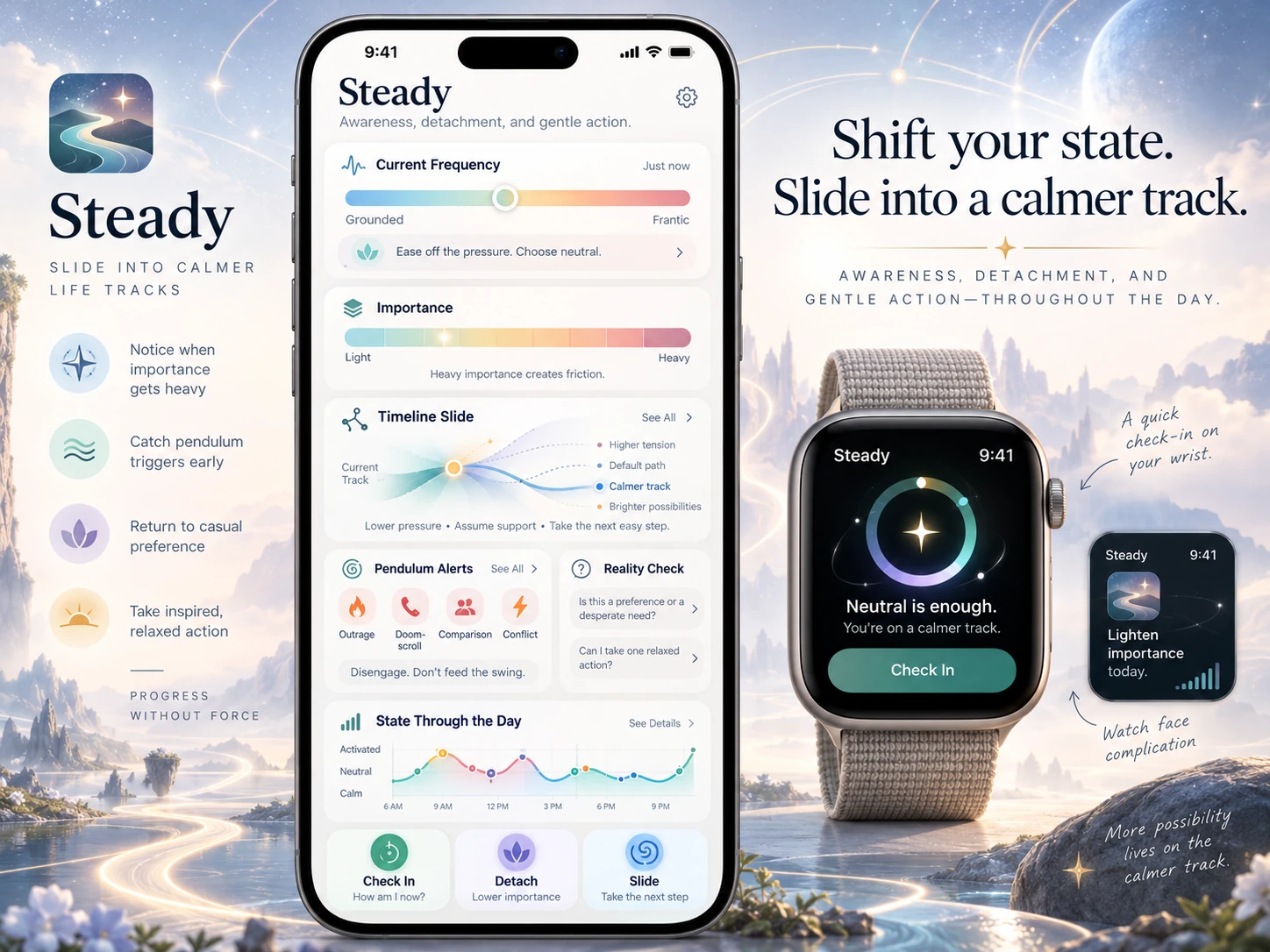
The first Steady concept mockup takes the Transurfing vocabulary literally, with a frequency dial and branching tracks. These are illustrative mockups, including the charts and readings, rather than a working app or measurements. What interests me is having a reminder to notice the pressure before I spend another day acting from it.
Other people’s scoreboards
Another Transurfing term is a pendulum. Its account of pendulums describes collective energetic structures that feed on emotional reactions. Admiration and outrage can both keep one going; fighting it keeps you involved.
As a metaphor for attention, I find that easy to recognize. A feed full of successful launches gives me a scoreboard I didn’t choose. I can admire the person with thousands of signups or resent them, and either reaction can end with me checking my own numbers again. The next feature starts to feel urgent because of somebody else’s afternoon.
I can close the feed without winning an argument with it. I can check whether anyone used my software at a time I’ve chosen, rather than whenever I want reassurance. Useful feedback still deserves attention. A developer explaining why the tool failed them is giving me something to work on; refreshing a vote count is mostly giving me another occasion to feel something.
I also don’t want “disengagement” to become an excuse to ignore a debt, a promise, or a person. Those obligations remain. I’m trying to stop spending the whole day emotionally arguing with a number.
I’d love it. I don’t require it.
There’s a trap in using detachment to get success. I could spend the day trying to feel casual so the universe will finally reward me with users. Then I’d be watching myself for anxiety, worried that wanting it too much was ruining everything. That sounds exhausting.
A strong preference with a weaker attachment seems more honest. I’d love thousands of people to use cubacadabra. Today I can ask one developer about something they’re trying to make. Their answer might be useful even if it doesn’t lead where I hoped.
For me, a practical version of the timeline-sliding idea would have three steps:
- Lower the stakes. Write down what I’d like to happen and what I’ll do if it doesn’t. This attempt gets to be one attempt.
- Proceed with enough confidence to try. I can send the message or show the rough tool without knowing how the whole business will work. I don’t need to assume the outcome is guaranteed.
- Change the approach when I learn something. If the developer doesn’t need the tool, ask about the problem they do have. Keep taking concrete action, with room for an answer I didn’t plan.
Backing off the imagined payoff may leave me bored for a while. I’ve been borrowing excitement from that future, so I shouldn’t be surprised if an ordinary afternoon of work feels quieter. I want to leave room to discover whether curiosity, craft, or helping somebody is enough for today’s task.
Transurfing can describe upheaval as moving away from an old life track. I’d be careful with that story. If work or a relationship starts falling apart, that deserves attention on its own terms. I don’t want to call damage evidence that a better reality is arriving.
Before I open the editor
Understanding this doesn’t keep me from slipping back into the frantic state. By the time I notice, the small tool can already have a name, a launch plan, and several years of imaginary users. From inside that excitement, adding another feature seems perfectly reasonable.
I want a few decisions made before I get there. Pick one small task in writing before opening the editor. Give the session 45 minutes. Put new repositories, domains, architecture pivots, and big spending on a list to reconsider in a few days. At the end, write what changed and the next small step, then leave the editor.
These are rules I want to try, not a routine I’ve already proved works. Stopping while something is unfinished may be the part I need most. I want to be able to care about a problem, work on it, and come back tomorrow.
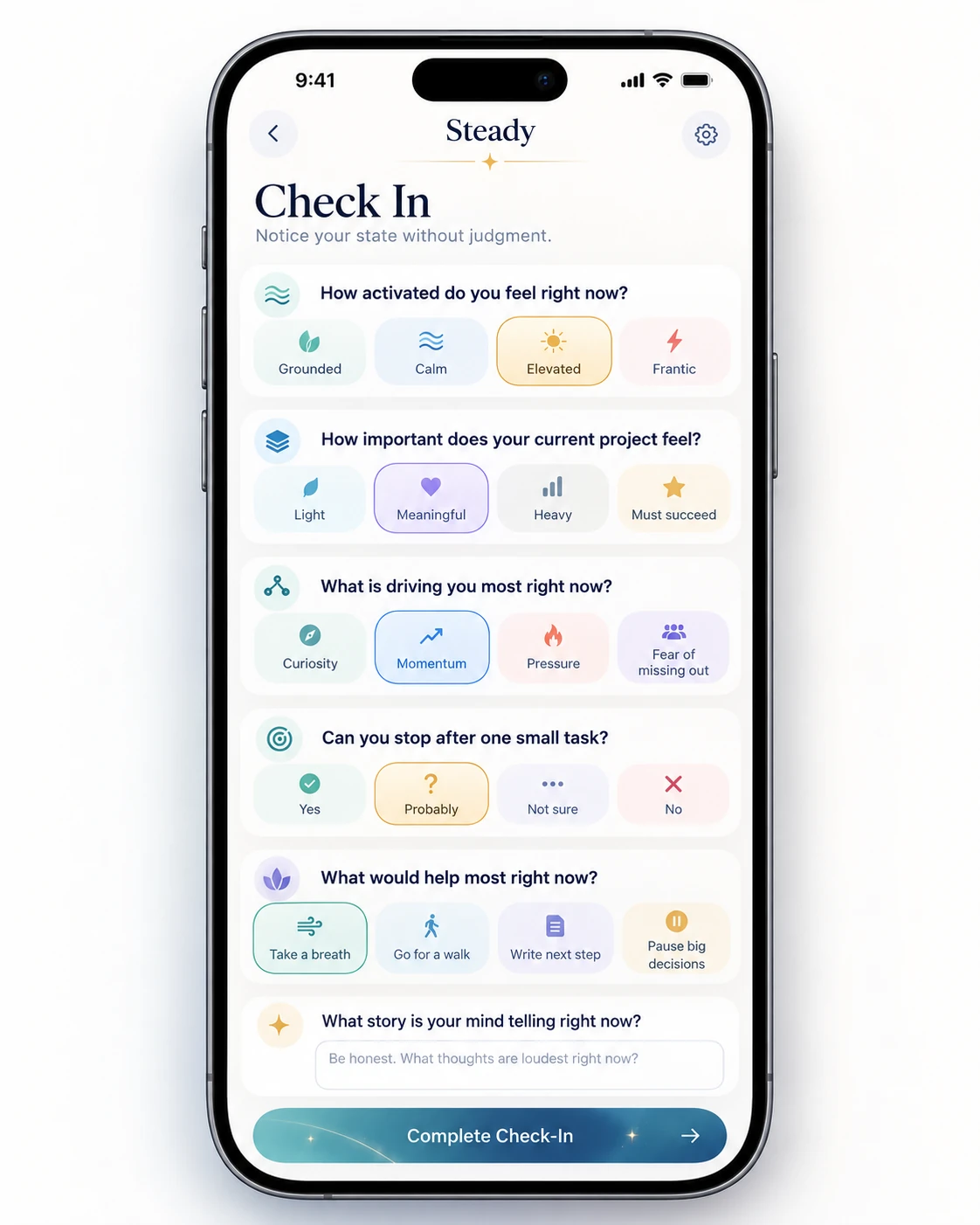
The check-in mockup puts a useful question beside “how do I feel?”: Can I stop after one small task? Excitement by itself doesn’t answer that. I can feel absorbed and still choose to eat, take a walk, or stop for the night. Feeling that I must finish immediately deserves a different response.
I’d keep three questions somewhere I can see them before a session:
- What am I trying to make happen today?
- Who specifically benefits from it?
- Would I still do today’s task if this never became huge?
The last answer won’t always be yes. Some work is a bet on a future return, and I still need to consider money. But if the only appealing part of a task is imagining how impressed people will be, I’d like to know that before committing another month to it.
When I notice the pressure returning, “I’m loading this project with importance again” is enough. I don’t need to decide the idea is bad or punish myself for getting carried away. Catching it after three hours would still be better than catching it after three months.
The app could become number eighteen
Of course there’s an awkward possibility sitting in these images. I could turn the idea of building more calmly into another enormous project. Phone app, watch app, charts, reminders, launch. Then I could become frantic about whether anybody wanted my app for becoming less frantic.
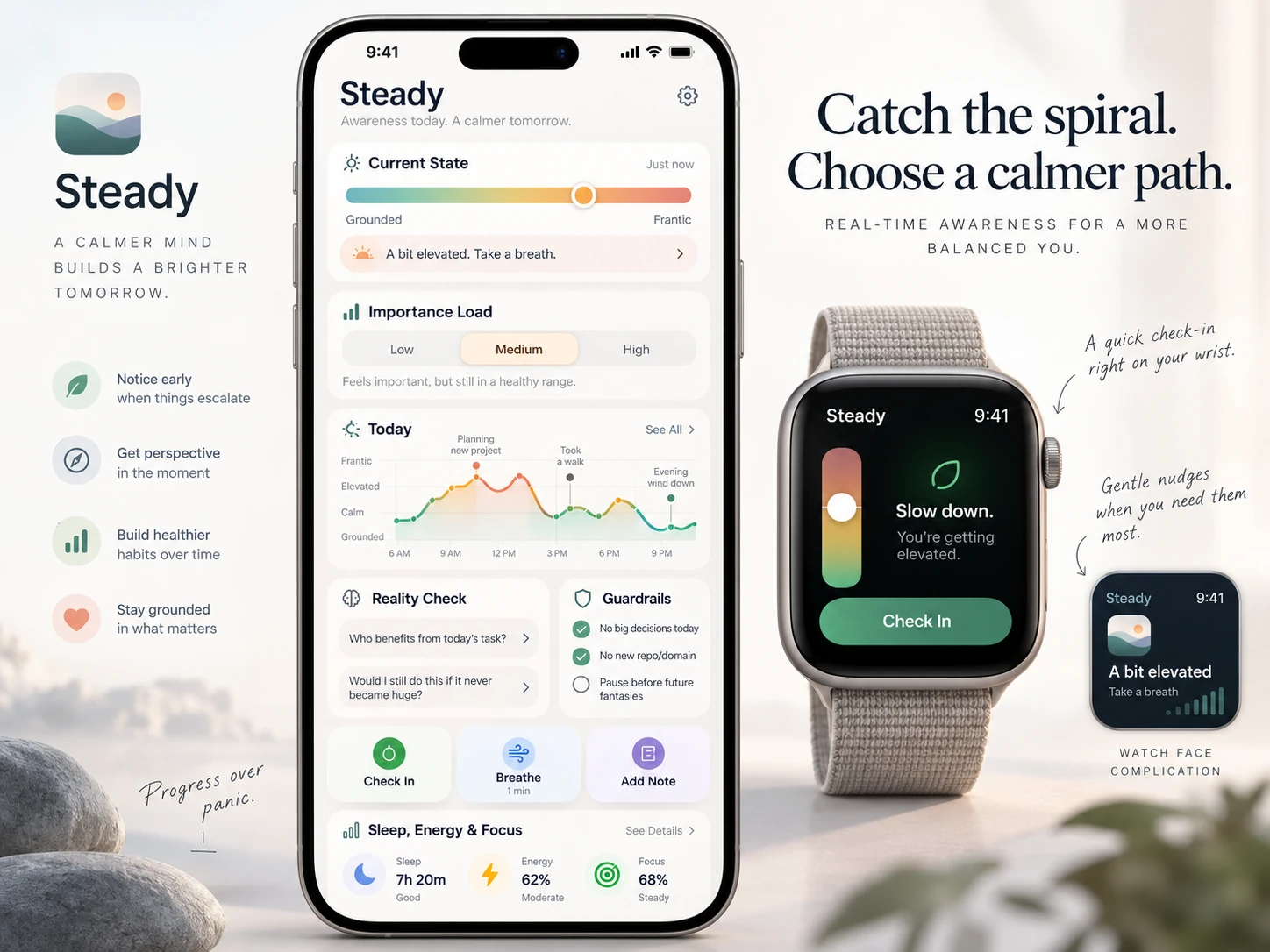
Steady is the name on the mockups. The plainer version below moves toward questions about the day and practical guardrails. I like the watch check-in because it suggests a reminder away from the editor. But a note beside the keyboard could ask the same question, and I’d want to try that before deciding I need a product.
I’ve got a word to remember this by: LIGHTNESS. It’s the quality I’m trying to bring to the work, and it gives me a few reminders when I catch myself getting urgent:
- Lower importance.
- Intend, don’t insist.
- Go gently.
- Hold outcomes lightly.
- Take the next step.
- Notice desperation.
- Expect possibilities, not guarantees.
- Stay grounded.
- Shift instead of force.
The difficult part will be using it when the next idea feels wonderful. I still want the pleasure of making something people care about, and I don’t know yet how much motivation will remain when I stop rehearsing the huge payoff. I’d like to find out on a small task I can finish, or deliberately leave until tomorrow, while the rest of my day still belongs to me.